


This guide covers decomposition timelines for every common container type, explains what actually happens inside a landfill, and gives you a practical framework for disposal when industrial composting isn't available nearby.

Three Terms That Get Confused - and Why It Matters
Biodegradable means a material can be broken down by microorganisms. The problem: almost everything qualifies eventually, including conventional plastics. The word is largely unregulated and tells you nothing about how long decomposition takes or under what conditions.
Compostable is more specific. A certified compostable product must break down within a defined timeframe (typically 90 to 180 days), leave no toxic residue, and meet recognized standards such as ASTM D6400 in the US or EN 13432 in the EU. The critical detail: most certified compostable products only meet these timelines inside industrial composting facilities - not in a home bin, and not in a landfill.
Recyclable is a separate category. Recycling is a mechanical reprocessing system, not a decomposition process. Most compostable containers cannot go in the recycling bin - doing so contaminates the recycling stream. For a broader look at how these distinctions apply to packaging choices, see our guide on eco-friendly takeout packaging.
| Term | Regulated? | Requires special facility? | Leaves useful residue? |
|---|---|---|---|
| Biodegradable | Largely no | Not necessarily | Not guaranteed |
| Compostable (certified) | Yes | Usually yes (industrial) | Yes - nutrient-rich compost |
| Recyclable | Yes (by material type) | Yes (recycling facility) | Reprocessed material |
Decomposition Times by Material
| Material | Industrial Compost | Home Compost | Landfill |
|---|---|---|---|
| Polystyrene foam | Does not compost | Does not compost | 500+ years |
| PP / PET / PE plastic | Does not compost | Does not compost | 400–1,000 years |
| PE-coated paper | Not accepted (most facilities) | 5+ years | 5+ years |
| PLA-lined paper | 3–6 months | Not effective | Years (minimal breakdown) |
| Sugarcane bagasse | 60–90 days | 90–120 days | Months to years (slowed) |
| Bamboo / straw fiber | 60–90 days | 2–6 months | Variable |
| Cornstarch / PLA blends | 3–6 months | Not effective (unless certified) | Years |
| CPLA (crystallized PLA) | 12+ months | Not effective | Years |

Conventional Plastics: PP, PET, and Polystyrene Foam
Standard plastic food containers - rigid takeout boxes, foam clamshells, clear deli containers - sit at the far end of the timeline. Polystyrene foam persists for 500 years or more. PP and PET plastics take between 400 and 1,000 years. Neither truly biodegrades: UV light and physical wear break them into smaller and smaller fragments - microplastics under 5mm that enter soil, water, and food chains. The FDA's microplastics research page documents their detection across food and beverage samples. Fragmentation is not decomposition; the polymer chains remain in the environment indefinitely.
One question buyers commonly raise: are black foam containers a bigger problem than clear ones? Chemically, the material behaves the same - but black plastic containers are harder to recycle because carbon black pigment blocks optical sorting equipment. For a full breakdown of which plastic types can actually be recycled, see our article on plastic food container recyclability.
PE-Coated Paper: Why Most Paper Cups Can't Be Recycled or Composted
Standard paper cups and food boxes are lined with a thin polyethylene (PE) film to prevent leaking. The paper layer can break down within months under the right conditions, but the PE coating blocks both composting and recycling. Most composting facilities don't accept PE-coated paper, and most curbside recycling programs reject it too because the coating can't be separated from the fiber. In practice, these containers typically take five or more years to degrade - and in landfill conditions, the timeline is similar. For a detailed look at coating types, our guide to paper cup coatings explains the differences and what to look for.
PLA and Cornstarch-Based Containers
PLA (polylactic acid) - used as a paper liner and in rigid cornstarch-based containers - is genuinely compostable, but only under industrial conditions. The reason is chemical: PLA's polymer chains break down through hydrolysis, a process that requires sustained temperatures above 55°C. Industrial composting facilities maintain these temperatures; most home piles don't reach them consistently. Under industrial composting, PLA-based containers break down in 3–6 months. In a landfill, they perform no differently than conventional plastic. Our guide to biodegradable takeaway containers covers how to evaluate whether local composting infrastructure exists before committing to PLA-based products.
Sugarcane Bagasse and Bamboo Fiber
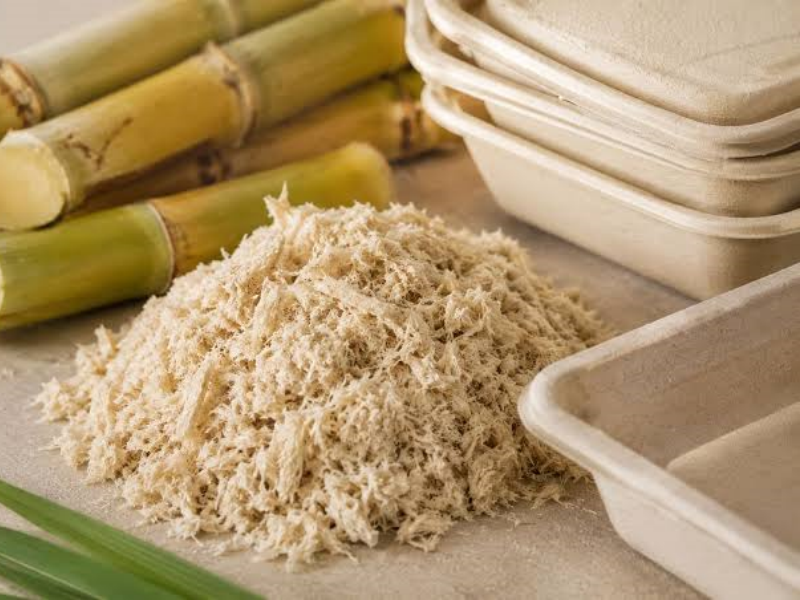
Bagasse - the fibrous byproduct from sugarcane processing - is among the fastest-degrading commercial packaging materials. Under industrial composting, it typically breaks down in 60–90 days. In a home compost pile, expect 90–120 days depending on moisture and temperature. Its relatively quick breakdown comes from its fiber composition: bagasse is high in cellulose and hemicellulose (the components microbes digest most efficiently) and lower in lignin than wood-based materials. Many bagasse products can be home composted, which gives them a practical advantage over PLA for users without industrial facility access - though it's worth checking for a specific home compostability certification.
Our compostable bagasse clamshell containers and bagasse bowls include certification details on their product pages. For a direct performance comparison with plastic, the bagasse vs. plastic takeout box comparison is a useful reference. Bamboo and straw fiber containers decompose at a similar rate - 2 to 6 months in natural or home composting environments - and are widely available with home compostability certification.
CPLA: The Slow-Composting Option
CPLA (crystallized polylactic acid) is engineered for heat resistance - it's used for hot-drink lids and cutlery. That crystalline structure slows decomposition significantly: while standard PLA breaks down in 3–6 months under industrial composting, CPLA typically takes 12 months or more. Like PLA, it requires industrial composting and won't break down in landfill or home compost. For hot-food applications where end-of-life matters, bagasse is generally more practical.
What Actually Happens in a Landfill
Landfills are anaerobic - buried material is cut off from oxygen. Without oxygen, the aerobic microbial processes that drive composting can't function. This is why even materials that compost quickly in the right facility degrade slowly or not at all when landfilled.
There's a further consequence: organic materials that do break down in anaerobic conditions produce methane rather than carbon dioxide. Methane is a potent greenhouse gas - over a 20-year period, it traps roughly 80 times more heat per unit than CO₂. According to the US EPA, composting diverts organic material from this methane-generating pathway. Sending certified compostable packaging to landfill doesn't just fail to deliver its environmental benefit - it actively converts organic matter into a more harmful emission than if it had stayed as plastic.
When There's No Industrial Composting Available
In the United States, fewer than 200 full-scale composting facilities accept food-soiled packaging, and most are concentrated in specific metro areas. If your area doesn't have access, here's a practical approach:
- Check local infrastructure before assuming. Search your municipality's waste management website, or use a composting locator, to see whether curbside organics collection in your area accepts certified compostable packaging - some programs do.
- Read the certification mark, not just the word "compostable." Look for TÜV OK Compost HOME (home compostable), BPI Certified (industrial), or EN 13432 (EU industrial). Our overview of EU and US packaging regulations covers what these marks require.
- Match material to what's actually available. Home compost bin: use uncoated paper, certified home compostable bagasse, or bamboo fiber. No composting access: PE-free paper containers are preferable to conventional plastics - they degrade faster in natural environments and don't generate persistent microplastic fragments.
- Reuse before disposing. Many containers - including food-grade PP - are more durable than they appear. Rinsing and reusing several times reduces per-use impact regardless of end-of-life. Our microwavable PP food containers are designed for repeated use.
Certification at a Glance
| Certification | Standard | What it means |
|---|---|---|
| BPI Certified | ASTM D6400 / D6868 (US) | Industrial composting only |
| TÜV OK Compost HOME | TÜV Austria | Home composting approved |
| TÜV OK Compost INDUSTRIAL | TÜV Austria | Industrial facility required |
| EN 13432 | European standard | Industrial composting |
| "Biodegradable" (no mark) | None - unregulated | Treat with caution |
If a container carries only the word "biodegradable" with no recognized mark, it tells you almost nothing about what will happen to it after disposal. Our sustainability page outlines the certifications we look for when sourcing packaging. For a full range of certified options, browse our biodegradable food containers or compare materials using our PP vs. PET vs. PS guide.
FAQ
Q: Do compostable food containers break down in landfills?
A: Not as designed. Certified compostable materials require the high temperatures and oxygen of industrial composting. In an anaerobic landfill, they degrade very slowly - often no faster than conventional plastics - and may release methane in the process. The environmental benefit is entirely conditional on reaching a composting facility.
Q: What is the fastest-decomposing food container material?
A: Sugarcane bagasse and bamboo fiber break down in 60–90 days under industrial composting and 90–120 days in home composting. Uncoated paper is comparable in natural environments. PLA-based materials compost in 3–6 months but require industrial facilities.
Q: Can I put compostable containers in my home compost?
A: Only if the product carries a home compostability certification such as TÜV OK Compost HOME. Most PLA and CPLA containers require industrial processing temperatures (above 55°C) that a standard home pile can't sustain. Bagasse and bamboo fiber containers are more likely candidates - but verify the specific product's certification before assuming.
Q: What's the difference between biodegradable and compostable containers?
A: Compostable is a regulated, specific subset of biodegradable - it requires meeting defined breakdown timelines and leaving no toxic residue. "Biodegradable" alone is unregulated and tells you little about actual decomposition speed or conditions. Look for the certification mark, not just the word on the label.
Q: Are PE-coated paper cups recyclable?
A: In most curbside programs, no. The PE lining prevents separation from the paper fiber, which is why most recycling systems reject paper cups. Specialized paper cup recycling programs exist in some regions but are far from universal.
Q: What happens when a plastic container decomposes?
A: It photodegrades rather than biodegrades. UV light and physical wear break plastic into progressively smaller fragments - eventually forming microplastics under 5mm. These particles don't disappear; they accumulate in soil and water systems. True biodegradation back into organic compounds doesn't occur with conventional plastics under typical environmental conditions.