


Introduction
Plastic food containers are widely used in takeaway, catering, fresh food packaging, and food delivery industries. Although injection-molded and thermoformed food containers are both common packaging solutions, they differ significantly in manufacturing process, structural performance, material efficiency, production cost, and application suitability. Understanding these differences can help food packaging buyers, distributors, and food service businesses choose the most appropriate solution based on product requirements, budget, and production scale.
What Are Injection-Molded Food Containers?
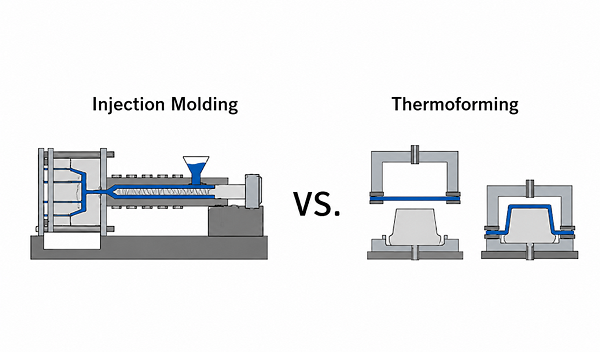
Injection-molded food containers are produced by injecting molten plastic material into a closed mold cavity under high pressure. After cooling and solidifying, the mold opens to release the finished product. This process produces containers with high dimensional accuracy, strong structural stability, and consistent surface quality. Injection molding is well-suited for manufacturing food containers with complex structures such as hinged lids, snap-lock closures, reinforcement ribs, and multi-compartment designs. Typical applications include reusable meal prep containers, hinged lunch boxes, microwave-safe food containers, and heavy-duty takeaway packaging.

What Are Thermoformed Food Containers?
Thermoformed food containers are manufactured by heating plastic sheets until they become flexible and then forming them over molds using vacuum or pressure forming technology. The formed sheets are then trimmed into individual packaging products. This process is highly efficient for producing lightweight and cost-effective food packaging at large production volumes. Thermoformed containers are commonly used for disposable takeaway boxes, fruit trays, salad bowls, bakery packaging, dessert containers, and clear food display packaging, where lightweight structure and product visibility are important.

Injection Molded Food Containers vs Thermoformed Food Containers: Key Differences
The table below highlights the main differences between injection-molded food containers and thermoformed food containers across several important packaging and production aspects.
|
Comparison Aspect |
Injection Molded Food Containers |
Thermoformed Food Containers |
|
Manufacturing Process |
Molten plastic injected into closed mold under high pressure |
Heated plastic sheet formed over mold and trimmed |
|
Tooling Investment |
Moderate to high depending on mold complexity and cavity count |
Lower tooling investment with simpler mold structures |
|
Production Efficiency |
Suitable for medium to high-volume production |
Ideal for high-volume disposable packaging production |
|
Structural Strength |
Strong and rigid structure |
Lightweight and flexible structure |
|
Structural Complexity |
Supports hinges, snap-locks, ribs, and compartments |
Best for simpler shapes and lightweight designs |
|
Material Efficiency |
Higher material consumption due to thicker walls |
Better material efficiency for lightweight packaging |
|
Production Lead Time |
Longer mold development and production preparation time |
Faster tooling development and shorter production cycle |
|
Surface Finish |
Consistent surface texture and dimensional stability |
Smooth display surface with lightweight appearance |
|
Common Materials |
plastic pellets |
plastic sheets |
|
Typical Applications |
Reusable containers, microwave-safe meal boxes, deli containers |
Salad containers, fruit trays, bakery packaging, disposable takeaway boxes |
Advantages and Limitations of Each Process
Understanding the advantages and limitations of each manufacturing method can help businesses select a packaging solution that better matches their operational and product requirements.
Injection Molded Food Containers
Advantages
• Strong structural stability and impact resistance
• Supports complex designs such as hinged lids and multi-compartment structures
• Better stackability and transportation stability
• Suitable for reusable and microwave-safe applications
• Consistent dimensional accuracy and surface quality
Limitations
• Higher tooling investment compared with thermoforming
• Longer mold development cycle
• Thicker walls may increase material consumption
• Less suitable for ultra-lightweight disposable packaging
Thermoformed Food Containers
Advantages
• Lower tooling investment and faster product development
• Lightweight structure with good material efficiency
• Excellent transparency for food display applications
• High-speed production suitable for large-scale disposable packaging
• Cost-effective for lightweight food packaging solutions
Limitations
• Generally, less rigid than injection molded products
• Limited ability to create highly complex structures
• Less suitable for heavy-duty or reusable packaging
• Structural stability may decrease with very thin-walled designs
How to Choose the Right Food Container for Your Packaging Needs
Choosing between injection-molded and thermoformed food containers depends largely on your production goals, budget, packaging style, and lead time requirements. While both processes are widely used for disposable food packaging, they offer different advantages in manufacturing efficiency and product characteristics.
Choose Injection-Molded Food Containers If:
- You need stronger and more rigid container structures
- Your packaging requires more detailed shapes or thicker walls
- Product consistency and dimensional precision are important
- You can accept longer tooling and production preparation times
- Your project supports higher initial mold investment for long-term production stability
Choose Thermoformed Food Containers If:
- You need faster production and shorter lead times
- Cost efficiency is important, especially for low- to medium-volume orders
- Lightweight disposable packaging is preferred
- Your packaging focuses on product visibility and display
- You want more flexible and faster mold customization
Conclusion
Injection-molded food containers and thermoformed food containers each offer unique advantages for different food packaging applications. Injection molding provides stronger structural performance, higher precision, and more complex packaging designs, while thermoforming offers lightweight construction, excellent transparency, and highly efficient large-scale production for disposable packaging. As a professional food packaging manufacturer, YANGRUI provides customized food packaging solutions for takeaway, fresh food, bakery, deli, and meal preparation applications, helping businesses find reliable and efficient packaging solutions for diverse food service needs. Contact us today to learn more about our food packaging products and customization services.