

Do biodegradable food containers have a different color - retention property?
As a supplier of biodegradable food containers, I've been intrigued by various aspects of these eco - friendly products. One question that often comes up, both from customers and within our research team, is whether biodegradable food containers have a different color - retention property compared to traditional non - biodegradable ones.
To understand this, we first need to delve into what biodegradable food containers are made of. Most of our biodegradable food containers are crafted from natural materials such as bagasse (sugarcane fiber), bamboo pulp, and cornstarch. These materials are not only renewable but also break down naturally in the environment, reducing the long - term waste burden.
Let's start by looking at the factors that affect color retention in general. For food containers, color retention is crucial as it impacts the overall aesthetic appeal, which can influence a customer's perception of the food inside. The color of a container can also convey a sense of quality and freshness.

In traditional non - biodegradable containers, such as those made from plastic or polystyrene, colorants are often added during the manufacturing process. These colorants are designed to be highly stable and resistant to fading. They are typically synthetic chemicals that can withstand a variety of environmental conditions, including exposure to light, heat, and moisture.
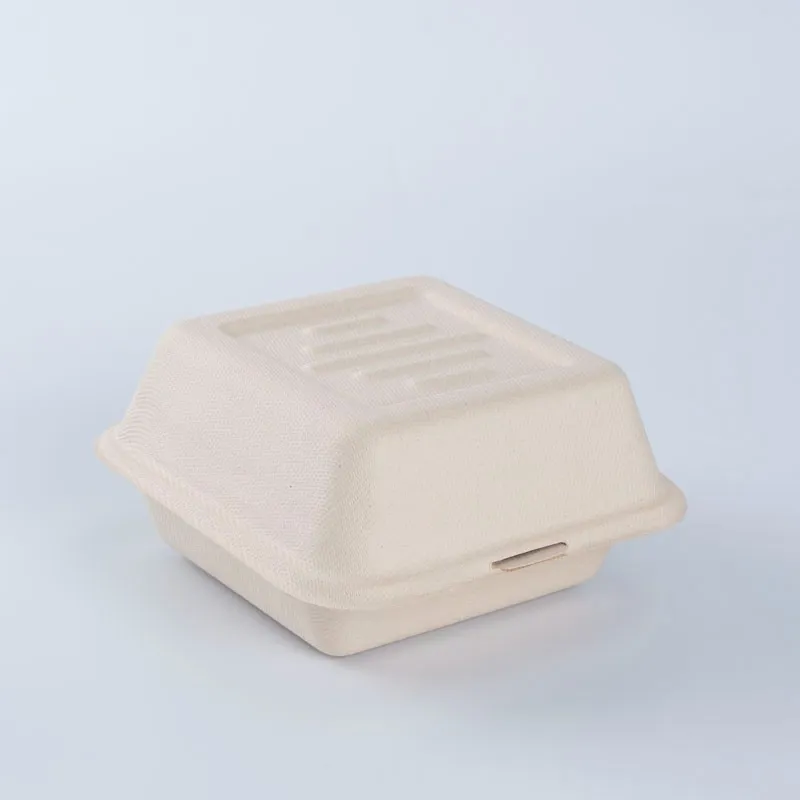
On the other hand, biodegradable food containers use natural colorants or rely on the inherent color of the raw materials. For example, our Compostable Clamshell Bagasse Take - Out Food Container gets its natural brownish - tan color from the bagasse material. This natural color is a result of the lignin and other components present in the sugarcane fiber.
One of the main differences in color - retention properties between biodegradable and non - biodegradable containers lies in their response to light. Ultraviolet (UV) light is a major culprit in causing color fading. Non - biodegradable containers often have UV stabilizers added to their formulation to protect the colorants from UV damage. Biodegradable containers, however, do not usually have these synthetic stabilizers. As a result, they may be more prone to color changes when exposed to direct sunlight for extended periods.
Heat is another factor that can affect color retention. When food is placed in a container, especially hot food, the temperature inside the container can rise. Traditional non - biodegradable containers are engineered to withstand high temperatures without significant color change. Biodegradable containers, due to their natural composition, may experience some color alterations at elevated temperatures. For instance, the natural pigments in bagasse - based containers can darken slightly when exposed to prolonged heat.
Moisture also plays a role. Non - biodegradable containers are generally more water - resistant, which helps in maintaining their color. Biodegradable containers, being made from natural materials, can absorb moisture. This absorption can cause the natural color to become more intense or, in some cases, lead to a slight discoloration. For example, if a Compostable Square Box For Takeout Food is exposed to a humid environment or comes into contact with a wet food item, the natural fibers may swell, and the color may change subtly.
However, it's important to note that these color changes in biodegradable containers are not necessarily a sign of poor quality. In fact, they can be seen as a characteristic of the natural and sustainable nature of the product. Customers who choose biodegradable containers are often more environmentally conscious and may appreciate the natural variations in color as a mark of authenticity.
We have conducted several internal studies to better understand the color - retention properties of our biodegradable food containers. In one study, we exposed samples of our Disposable Bagasse Round Plate Natural 100% Compostable to different environmental conditions. We placed some plates in direct sunlight, others in a hot oven, and some in a humid chamber. After a set period, we observed the color changes.
The plates exposed to sunlight showed a slight lightening of the color, especially on the parts that were most directly exposed. The plates in the oven had a slight darkening effect, particularly around the edges where the heat was most concentrated. And the plates in the humid chamber had a more uniform change in color, becoming slightly darker and more saturated.
Despite these color changes, the structural integrity of the plates remained intact, and they were still fully functional for their intended purpose of holding food. This indicates that while the color - retention properties of biodegradable containers may be different from traditional ones, they do not compromise the usability of the product.
In the market, there is a growing demand for biodegradable food containers, not only because of their environmental benefits but also because of their unique aesthetic appeal. The natural colors of these containers can add a rustic and earthy charm to the food presentation. Restaurants, cafes, and food vendors are increasingly recognizing this and are willing to accept the minor color variations as part of the overall package.
From a manufacturing perspective, we are constantly looking for ways to improve the color - retention properties of our biodegradable food containers. We are exploring the use of natural UV - blocking agents and heat - resistant coatings derived from plant - based sources. These solutions would help to minimize color changes while still maintaining the biodegradable and compostable nature of the products.
In conclusion, biodegradable food containers do have different color - retention properties compared to traditional non - biodegradable ones. They are more sensitive to light, heat, and moisture due to their natural composition and lack of synthetic stabilizers. However, these differences are not necessarily negative. They can be seen as a unique characteristic that adds to the appeal of the product.
If you are in the food service industry and are interested in our biodegradable food containers, we invite you to reach out to us for a procurement discussion. We can provide you with samples to see the color - retention properties firsthand and discuss how our products can meet your specific needs.
References
- "The Science of Biodegradable Materials" - A research paper on the properties of biodegradable polymers and their applications.
- "Food Packaging and Color Perception" - A study on how the color of food containers affects consumer perception.
- Internal research reports from our company on the color - retention properties of biodegradable food containers.