


This guide is written for restaurant owners, catering managers, and procurement buyers sourcing hot soup containers to go at scale. It covers seven material types, ranked by what actually matters: heat tolerance, leak resistance, sustainability credentials, and cost. Skip to the Quick Pick table if you already know your use case.

Quick Pick: Match Your Operation to the Right Material
Most buyers searching for disposable soup bowls for restaurants already have a clear use case. Start here:
- High-volume takeout or delivery → Kraft paper with PLA lining - leak-proof, printable, cost-effective at scale
- Full compostability required → Bagasse (sugarcane fiber) - no plastic coating, widely certified
- Oven or broiler reheating → Aluminum foil - the only disposable option that goes from fridge to oven
- Premium events or eco-forward catering → Palm leaf or molded fiber - strong sustainability story, elevated appearance
- Institutional buying, cost is the primary driver → PP plastic - lowest cost, high durability, needs a recycling plan
- Replacing foam and not sure where to start → Bagasse or molded fiber - closest performance match, cleaner regulatory position
Note on Foam (EPS): Foam soup bowls are banned or restricted in the EU under the Single-Use Plastics Directive, as well as in California, New York State, and a growing list of US municipalities. Foam is not covered in this guide as a current recommendation.
What Makes a Bowl Actually Safe for Hot Soup?
Before comparing materials, it helps to know what you're evaluating them against.
Heat Tolerance
A bowl needs to hold liquid at 85–100°C (185–212°F) for at least 20–30 minutes without warping, softening, or releasing its lining. "Heat resistant" on a product label means nothing without a specific temperature threshold and tested hold duration - always ask suppliers for both.
Leak Resistance
Four factors determine whether a bowl leaks: the interior coating or lining, wall thickness and rigidity, seam construction, and lid-to-rim fit. A bowl without a matched lid is a delivery liability. The lining type also determines whether the bowl is compostable - PE coatings resist moisture effectively but are not compostable; PLA coatings compost in industrial facilities but cost slightly more.
Certifications: What They Mean for Buyers
When sourcing, you'll encounter certification names that suppliers reference without explaining. The key ones, per FDA food contact materials guidelines and international standards:
- FDA 21 CFR - Confirms food-safe material for the US market. Required for any bowl used in US foodservice.
- EN13432 - EU compostability standard. Required for eco claims in European markets. See our certificates overview for how we document compliance.
- ASTM D6400 - US industrial compostability standard, equivalent to EN13432 for North American markets.
- BPI Certified - Third-party verification by the Biodegradable Products Institute. The most recognized compostability mark in North America.
- LFGB - German food safety standard widely accepted across EU and Asian markets.
A self-declared "compostable" label with no third-party certification is not sufficient for compliance-sensitive markets. Request the actual certificate documents, not just a claim.

7 Material Types: What Buyers Need to Know
1. Bagasse (Sugarcane Fiber) Bowls
Bagasse is the fibrous byproduct of sugar production - an agricultural waste material pressed into bowl form under heat and pressure. No plastic coating is required, which is what makes it genuinely different from most paper alternatives.
Heat and leak performance: Reliable hold at boiling temperatures for 30–45 minutes under normal service conditions. Dense fiber structure resists oil and moisture penetration. Microwave-safe for short reheating (1–2 minutes). Slightly less insulating than foam, but adequate for most delivery windows.
Eco credentials: These compostable soup bowls break down in 60–90 days under industrial composting conditions. Widely certified under BPI, EN13432, and ASTM D6400. The strongest option for operations with documented green packaging requirements. Our bagasse soup and salad bowls are a direct example of this format.
Cost reference: Mid-range. Typically $18–$28 per 100 units at standard MOQ, depending on size and certification tier.
Best for: Eco-focused restaurants, catering operations, and buyers in EU or US markets with green packaging mandates. See the full range of biodegradable food containers for related formats.

2. Kraft Paper Soup Bowls
Kraft paper bowls are among the most commonly sourced disposable soup bowls for high-volume operations - but the lining decision changes everything about performance and end-of-life.
PE-lined vs. PLA-lined - this is the decision that matters:
- PE (polyethylene) lining: Effective moisture barrier, lowest cost option, widely available. Not compostable. Cannot be recycled due to mixed materials. The right choice when eco claims are not a factor.
- PLA (polylactic acid) lining: Comparable leak performance. Industrially compostable. Slightly higher per-unit cost. The required choice when marketing compostable packaging to customers. Always confirm which lining is in the product you're ordering - it's often not obvious on the outer packaging.
Paper soup bowls for hot liquid with appropriate PLA lining hold structure at up to 95°C for 30+ minutes. Good stack stability for storage and transit. The outer kraft surface accepts full-color custom printing, making it a strong choice for branded packaging.
Cost reference: PE-lined at $10–$16 per 100 units; PLA-lined at $14–$22 per 100 units at standard MOQ.
Best for: High-volume takeout, delivery, and any operation where branded packaging adds perceived value.

3. Molded Fiber Bowls
Molded fiber bowls are made from pulped plant material - typically a blend of bagasse, recycled paper, bamboo, or wheat straw - pressed into rigid forms. Unlike standard kraft bowls, they tend to feel more substantial in hand and have a more refined matte finish.
The PFAS issue you need to know about: Older molded fiber products used PFAS (per- and polyfluoroalkyl substances) coatings for grease resistance. According to the US EPA, PFAS are persistent environmental contaminants that don't break down in composting. Ensure any product you source is explicitly labeled PFAS-free - this is now standard from reputable manufacturers, but it requires confirmation. A bowl that isn't PFAS-free cannot be composted cleanly.
Performance: Solid heat and moisture resistance for 30–45 minutes. Thick walls provide better insulation than standard paper. Handles soup, noodle bowls, grain bowls, and stews - the most versatile format on this list for mixed menus. For a related biodegradable option, see our compostable clamshell takeout containers.
Cost reference: $20–$35 per 100 units depending on fiber blend and surface treatment.
Best for: Fast-casual dining and premium takeout where presentation quality matters as much as function.

4. CPLA / Cornstarch Bowls
This is the most misunderstood category on this list, and the sourcing error here is frequent: standard PLA softens at relatively low temperatures - it is not suitable for hot soup. CPLA (crystallized PLA) undergoes a heat treatment process that raises its structural tolerance to approximately 90–100°C.
Before placing an order, verify in the product spec whether you're getting PLA or CPLA. The difference is not cosmetic - standard PLA will deform on contact with boiling broth. CPLA won't. Seamless one-piece construction eliminates seam leaks, and it performs well for single-use hot-fill service. Not recommended for repeated microwave reheating.
Eco credentials: Industrially compostable. Derived from renewable plant sources (typically corn). Less effective in home compost - requires industrial facility conditions.
Cost reference: $16–$24 per 100 units at standard MOQ.
Best for: Zero-waste events and foodservice operations with confirmed access to industrial composting infrastructure.

5. Palm Leaf Bowls
Palm leaf bowls are made from naturally shed Areca palm leaves - no trees are cut, no coatings are applied. Each leaf is cleaned and heat-pressed individually, resulting in a warm-grain finish that is genuinely distinctive on a table.
Where they work and where they don't: These bowls are not a delivery product. Extended liquid contact - typically beyond 45–60 minutes - causes gradual softening. For seated service where the bowl is used and cleared within the meal, they perform well. For delivery where soup may sit for an hour, they are the wrong choice. Heat tolerance is good for immediate service; natural moderate water resistance holds for a normal dining window.
Eco credentials: 100% natural, compostable within 60 days in both home and industrial settings. Minimal processing, no virgin material extraction.
Cost reference: $35–$55 per 100 units - the premium end of this category.
Best for: Upscale events, eco-forward venues, and premium catering where the sustainability narrative and visual presentation are both selling points.
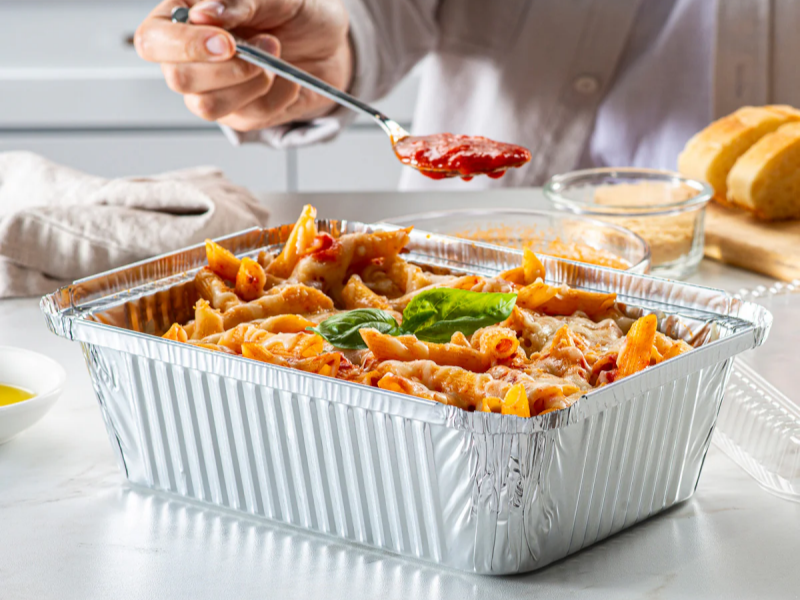
6. Aluminum Foil Bowls
Unlike every other option on this list, aluminum foil bowls solve a problem no other disposable can: oven and broiler service. If your operation reheats food in the container, this is the only material that works.
Thermal conductivity is high - bowls heat quickly and evenly, and move from cold storage to oven without structural issues. Completely impermeable: no liquid loss regardless of fill level or transit movement. Handle with care - exterior becomes very hot, which some operations address with cardboard sleeves or nested trays.
On recyclability: Aluminum is infinitely recyclable without quality degradation, and recycling it requires roughly 5% of the energy needed to produce new aluminum from ore. The environmental benefit, however, depends entirely on the bowl being recovered and recycled - not discarded. In service contexts where customers discard rather than return packaging, the recyclability advantage is largely theoretical.
Cost reference: $22–$38 per 100 units depending on gauge and size.
Best for: Oven-to-table service, institutional meal delivery, airline catering, and any context where reheating in-container is a service requirement.
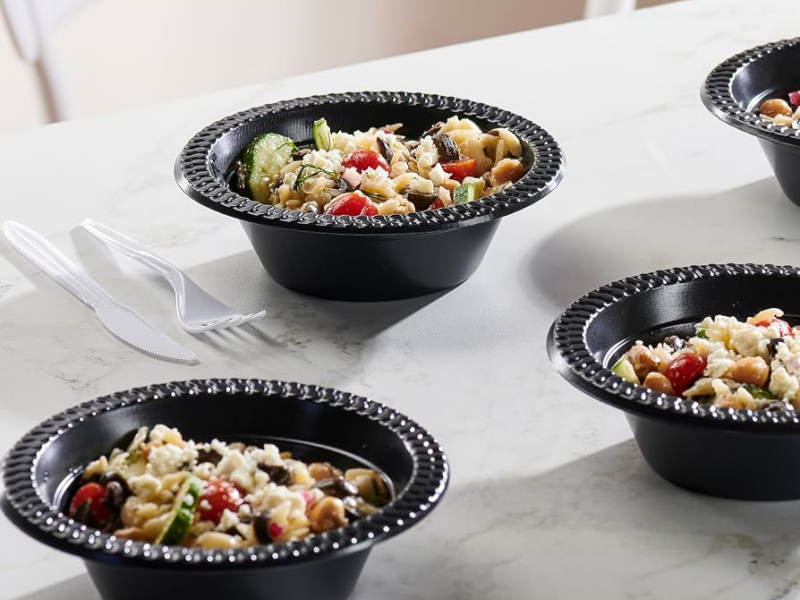
7. PP (Polypropylene) Plastic Bowls
PP is the practical workhorse of disposable foodservice. Heat-tolerant up to approximately 120°C, rigid, impermeable, and inexpensive - and unlike most disposables, many PP bowls can be washed and reused several times before disposal, which changes the real cost-per-use calculation. Our plastic microwavable containers include several PP formats suited to hot food service.
The regulatory reality for 2024 and beyond: PP (#5 plastic) is technically recyclable, but acceptance rates vary widely by region. Regulatory pressure on single-use plastics is increasing - the EU SUP Directive and US state-level legislation are both moving in the same direction. If you operate in affected markets, factor compliance trajectory into your sourcing decisions alongside per-unit price.
Cost reference: $8–$14 per 100 units - consistently the lowest cost option on this list.
Best for: Cost-constrained, high-volume operations where local recycling infrastructure is in place and regulatory environment permits continued use.
Side-by-Side Comparison
| Material | Heat Tolerance | Leak Resistance | Compostable? | Key Certification | Cost / 100 units (approx.) | Best Use Case |
|---|---|---|---|---|---|---|
| Bagasse | ≤100°C / 30–45 min | Excellent | Yes (industrial) | BPI / EN13432 | $18–$28 | Eco restaurants, catering |
| Kraft + PLA | ≤95°C / 30 min | Excellent | Yes (industrial) | FDA / ASTM D6400 | $14–$22 | High-volume takeout, delivery |
| Kraft + PE | ≤95°C / 30 min | Excellent | No | FDA | $10–$16 | Budget takeout, no eco claim |
| Molded Fiber | ≤100°C / 30–45 min | Very Good | Yes (PFAS-free) | BPI / EN13432 | $20–$35 | Fast-casual, premium takeout |
| CPLA / Cornstarch | ≤100°C / single use | Excellent | Yes (industrial) | ASTM D6400 | $16–$24 | Zero-waste events |
| Palm Leaf | ≤120°C / short duration | Good (45–60 min) | Yes (home + industrial) | Natural / none required | $35–$55 | Premium events, seated service |
| Aluminum Foil | Oven-safe | Excellent | No (recyclable) | FDA | $22–$38 | Oven reheating, airline catering |
| PP Plastic | ≤120°C | Excellent | No | FDA | $8–$14 | High-volume, where recycling exists |
Price ranges are approximate and based on standard MOQ orders (typically 2,000–5,000 units per SKU). Actual pricing varies by supplier, size, and market.
Lid Compatibility: The Detail That Causes the Most Problems
A bowl that holds boiling soup without leaking is useless if the lid comes loose in a delivery bag. Lid compatibility is one of the most commonly overlooked factors in disposable bowl sourcing - and one of the most expensive mistakes to discover after a bulk order arrives.
Three lid types and their real trade-offs:
- Paper lids - compostable, low cost, acceptable for counter service. Not reliable for delivery over distance.
- PLA lids - clear, compostable, better seal than paper. The preferred option for compostable soup bowls used in delivery.
- PP lids - snap-seal, highest security for transit, not eco-friendly. Best choice when spill prevention is the priority over sustainability claims.
Rim compatibility is not universal. A 16 oz bowl from one manufacturer often does not accept a lid from another, even at the same nominal size. Our round leak-proof bowls with lids and leak-proof PP portion cups are specified as matched sets precisely for this reason. Always request a sample that includes the lid, fill it, seal it, lay it on its side, and hold it for 20 minutes before placing a bulk order.

Before You Order in Bulk: 5 Things to Verify
For practical guidance on the best way to transport soup for takeaway, and to understand what separates reliable sourcing from costly surprises, check these five points before committing to volume:
- Request food-safety certificates in PDF. Ask for FDA, LFGB, or EN13432 documentation. A reputable supplier sends these without hesitation. Slow or vague responses on certification are a meaningful signal about overall reliability. Review our quality control process to understand what a documented standard looks like.
- Clarify minimum order quantities upfront. Most manufacturers start at 2,000–5,000 units per SKU for standard sizes. Custom printing or OEM branding typically requires 10,000+ units, though this varies by supplier. Confirm before assuming flexibility.
- Test samples under real conditions. Fill the sample with your actual soup at serving temperature. Apply the lid. Let it sit for 30 minutes. Put it in a bag and move it around. Simulate your actual delivery conditions - not a controlled environment.
- Build in lead time buffer. Standard production from overseas manufacturers runs 15–30 days plus shipping. Plan 6–8 weeks for first orders, more around peak seasons.
- Understand what OEM printing actually involves. Custom branding involves a one-time plate setup fee plus a per-unit print cost. It becomes cost-effective at volume (generally 10,000+ units) and meaningfully improves perceived quality at point of service.
5 Common Mistakes When Sourcing Disposable Soup Bowls
Mistake 1: Assuming "Biodegradable" Means It Breaks Down Anywhere
Bagasse, CPLA, and most molded fiber bowls require industrial composting conditions - specific temperature and microbial activity levels that a backyard compost pile cannot provide. If you're marketing compostable packaging to customers, confirm your disposal chain routes to an industrial facility. Our sustainability page covers how we approach end-of-life documentation for the products we supply.
Mistake 2: Calculating Cost Per Bowl, Not Total Cost
A cheap bowl with an incompatible lid, a 3% defect rate, or a compliance issue in your market costs significantly more than a slightly pricier option that works reliably. Factor lid cost, waste from defects, and potential regulatory exposure into your real cost calculation.
Mistake 3: Ordering Without Testing the Lid
Lid fit issues are among the most common and costly sourcing errors. Discovering after 50,000 units arrive that the lid doesn't seal properly is avoidable. Always test the bowl and lid together before bulk commitment.
Mistake 4: Not Checking Local Regulations Before Ordering Foam
Foam (EPS) containers are banned or restricted in California, New York State, the EU, and a growing number of cities globally. Regulations are expanding, not contracting. Verify before ordering into any new market.
Mistake 5: Confusing PLA and CPLA
Standard PLA will deform in contact with boiling soup. CPLA will not. This distinction is frequently missed in procurement because the names look identical. Always verify the specific bioplastic type in the product spec sheet - not just the marketing description.
FAQ
Q: Are paper soup bowls safe for hot liquids?
A: Yes, with the right inner coating. Kraft paper bowls with PE or PLA lining are designed to hold boiling liquid safely for 30+ minutes. Uncoated paper absorbs moisture immediately - never use it for hot soup service.
Q: What is the most eco-friendly disposable soup bowl?
A: Bagasse without question. It uses agricultural byproduct, requires no plastic coating, and is certified compostable under BPI, EN13432, and ASTM D6400. PFAS-free molded fiber is a close second with a more refined finish.
Q: Can I microwave disposable soup bowls?
A: Bagasse and PLA-lined kraft bowls are typically microwave-safe for 1–2 minutes. Aluminum foil bowls cannot be microwaved. PP bowls labeled microwave-safe handle reheating reliably. Always verify the specific product rating - not all products within a material type carry the same specification.
Q: What is the difference between PLA and CPLA?
A: PLA softens at relatively low temperatures and is unsuitable for hot soup. CPLA is crystallized PLA, heat-treated to withstand 90–100°C. Always confirm which type you're ordering - the difference is significant for hot-liquid service.
Q: Where do I source quality disposable soup bowls?
A: For restaurants and foodservice operations, the best sourcing path is direct from a certified manufacturer rather than through multiple intermediaries - you get documentation, MOQ flexibility, and direct access to custom options. Verify FDA or LFGB certification before committing to any supplier. Our full range is available in the products section.
Q: What size should I order for soup service?
A: 8 oz for side portions and sauces, 12–16 oz for standard soup servings, 20–32 oz for ramen, noodle dishes, and large catering portions. If you're standardizing on one size, 16 oz covers the widest range of soup service use cases without over-sizing for standard portions.
Q: How do I store bulk disposable bowls?
A: Store in a dry, climate-controlled environment away from direct sunlight. Humidity is the primary enemy of paper-based bowls - bagasse and kraft products can absorb moisture in storage, which affects rim integrity and lid seal quality. Aluminum and PP products are not affected by humidity and have effectively unlimited shelf life under normal conditions.
The Bottom Line
If you're sourcing for a delivery-focused restaurant and compostability matters to your brand, kraft paper with PLA lining is the practical starting point - cost-effective, certified, and lid-compatible at scale. If compostability is your non-negotiable priority and you have access to industrial composting infrastructure, bagasse is the stronger choice: no plastic component, fully certified, and increasingly well-supported by regulation.
For everything else - oven reheating, premium events, institutional budgets, or foam replacement - the material choice follows directly from the use case. The mistake is choosing based on a single factor. Real procurement decisions balance heat performance, lid compatibility, end-of-life pathway, and what the cost looks like at your actual volume - not just the per-unit price.
Request samples before committing to bulk. Verify certifications before making eco claims. Test the lid before you order the bowl.